
The Temple That Moved With Houston
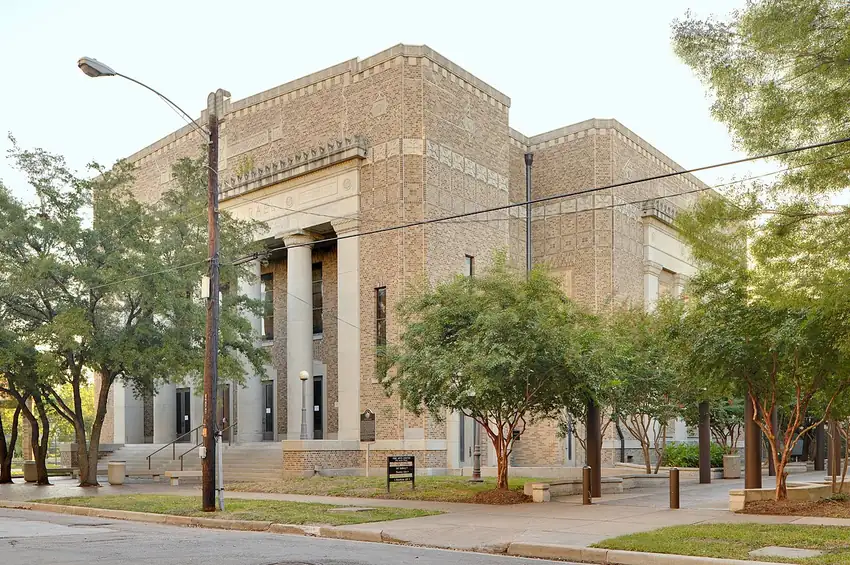
Quick facts about Beth Israel
- Congregation Beth Israel dates its founding to 1854, and the state granted it a charter in 1859.
- Its Texas Historical Commission marker calls it the oldest Jewish congregation in Texas.
- Its first permanent synagogue opened in 1874 on Franklin Avenue.
- The congregation has had four temples, each one farther south, the last opened in June 1967 on North Braeswood Boulevard.
- Rabbi Henry Barnston led the congregation for 43 years.
- The 1925 temple on Austin Street is now Houston Community College’s Heinen Theatre.
In June 1870, more than 1,000 people marched down Main Street in Houston to watch a cornerstone go into the ground on Franklin Avenue. It was for the congregation’s first permanent synagogue. When the building opened its doors in 1874, Congregation Beth Israel finally had a lasting home.
The congregation was older than the building. The congregation dates its founding to 1854, and the state granted it a charter in 1859.
Its Texas Historical Commission marker calls it the oldest Jewish congregation in Texas. In those first years it met in a small room on Austin Street downtown, then in a frame building on LaBranch. Houston’s Jewish families had also organized a burial ground, and a benevolent society to look after it and to help neighbors in need.
Jewish life in Houston is nearly as old as the town. The Goldring/Woldenberg Institute of Southern Jewish Life records a minyan, the quorum of ten needed for communal prayer, in 1837. Jacob De Cordova helped create the city’s Chamber of Commerce in 1840 and served as an alderman. Lewis Levy bought land from Sam Houston in 1843. By 1860, 108 Jews lived in Houston, and Jewish merchants owned 15 percent of its stores. Two Jewish Houstonians, Morris Levy and Henry Fox, helped push the project to connect the city to the Gulf, the waterway that would become the Houston Ship Channel.
For the next century, Jewish history in Houston can be followed through the addresses of that one congregation, and through the man who led it longest.
Henry Barnstein was born in Dover, England, in 1868, and came to Houston in 1900 to serve as Beth Israel’s rabbi. After World War I he changed his name to Barnston, to sound less German. He led the congregation for 43 years. Outside the pulpit, he is credited with forming the Houston Symphony Society and with founding a Jewish welfare service. Under him the congregation outgrew its first temple, and in 1908 it dedicated a larger Romanesque synagogue at Crawford and Lamar streets.
The city’s Jewish community was changing around him. Immigrants from Eastern Europe, many of them Orthodox, built congregations of their own. Adath Yeshurun formed in 1891. Adath Israel was founded in 1905 by 16 men in the Fifth Ward, and Adath Emeth began in the Sixth Ward in 1910. Between 1907 and 1914, the Galveston Movement, which steered Jewish immigrants through the port of Galveston instead of the crowded East Coast, brought hundreds more to Houston. A Yiddish Library Society opened in 1916. By 1927, an estimated 11,000 Jews lived in Houston.
Some of the city’s best-known businesses grew out of that community. Harris Weingarten opened a grocery in 1901, and his son Joe turned it into a chain that pioneered self-service shopping and had 70 stores by the time he died in 1967. Simon and Tobias Sakowitz opened a clothing store in 1915 that became the Sakowitz department stores. By the 1920s, Foley’s and Battlestein’s were Jewish-owned as well.
In 1925, Beth Israel moved again, to a new temple at Austin Street and Holman Avenue. It was designed by one of the congregation’s own members, the architect Joseph Finger: a building with massive columns that blends classical and Near Eastern details in an Art Moderne style. To build it, the congregation borrowed $100,000 from the William Marsh Rice Institute. By the time Barnston retired in 1943, Beth Israel counted a record 807 families.
His retirement opened the congregation’s deepest divide. The board chose as his successor Rabbi Hyman Judah Schachtel, who opposed the idea of a Jewish state, over associate rabbi Robert Kahn, a Zionist then serving as a military chaplain. It also adopted a set of “Basic Principles” for voting members that rejected a Jewish homeland, according to the institute’s history. Members who disagreed left. In 1944 they founded Congregation Emanu El, which describes its founding principles as “support for Israel and the freedom of expression of both pulpit and pew,” and Kahn served as its rabbi until 1978. Schachtel later came to support the Jewish state, and the Basic Principles were revoked in the 1960s. Both congregations are still in Houston.
By then the neighborhoods were moving too. In the 1920s and 1930s, Jewish families left the downtown wards for Washington Terrace and Riverside Terrace, south of downtown. By the mid-1930s, Riverside Terrace had become the preferred neighborhood of the city’s Jewish elite, in part because the River Oaks Corporation discouraged Jewish home purchases in River Oaks, according to the Society of Architectural Historians. Later, as Black families moved into those neighborhoods, many white residents, Jewish families among them, moved out, and many settled in Meyerland, in southwest Houston, in the 1950s and 1960s.
The congregations followed. Adath Emeth sold its building to Texas Southern University in 1959 and rebuilt on North Braeswood. Beth Yeshurun, formed when Adath Yeshurun and Beth El merged in 1946, finished a synagogue on Beechnut Street in Meyerland in 1962. In June 1967, Beth Israel opened its fourth temple, on North Braeswood Boulevard.
There is more than one way to read that move. One reading is a community prospering and building outward with a fast-growing city. Another is a map drawn partly by exclusion: Jewish families steered away from one neighborhood, then white families, Jewish ones among them, leaving another as Black families arrived. Both readings rest on the same record.
The temple on Austin Street did not sit empty. Beth Israel passed it to the Houston Independent School District in 1967, and in 1971 it became the first home of the High School for the Performing and Visual Arts. Houston Community College moved in in 1982, and the building is now its Heinen Theatre, a Recorded Texas Historic Landmark listed on the National Register of Historic Places.
Houston’s Jewish community kept growing after the move. By 2011 there were 23 congregations in the area, up from six forty years earlier. The synagogue whose cornerstone that crowd watched go into the ground in 1870 was the first of four homes for Beth Israel, each one farther south. The city was moving the same way.


