
The Apartments That Made Gulfton
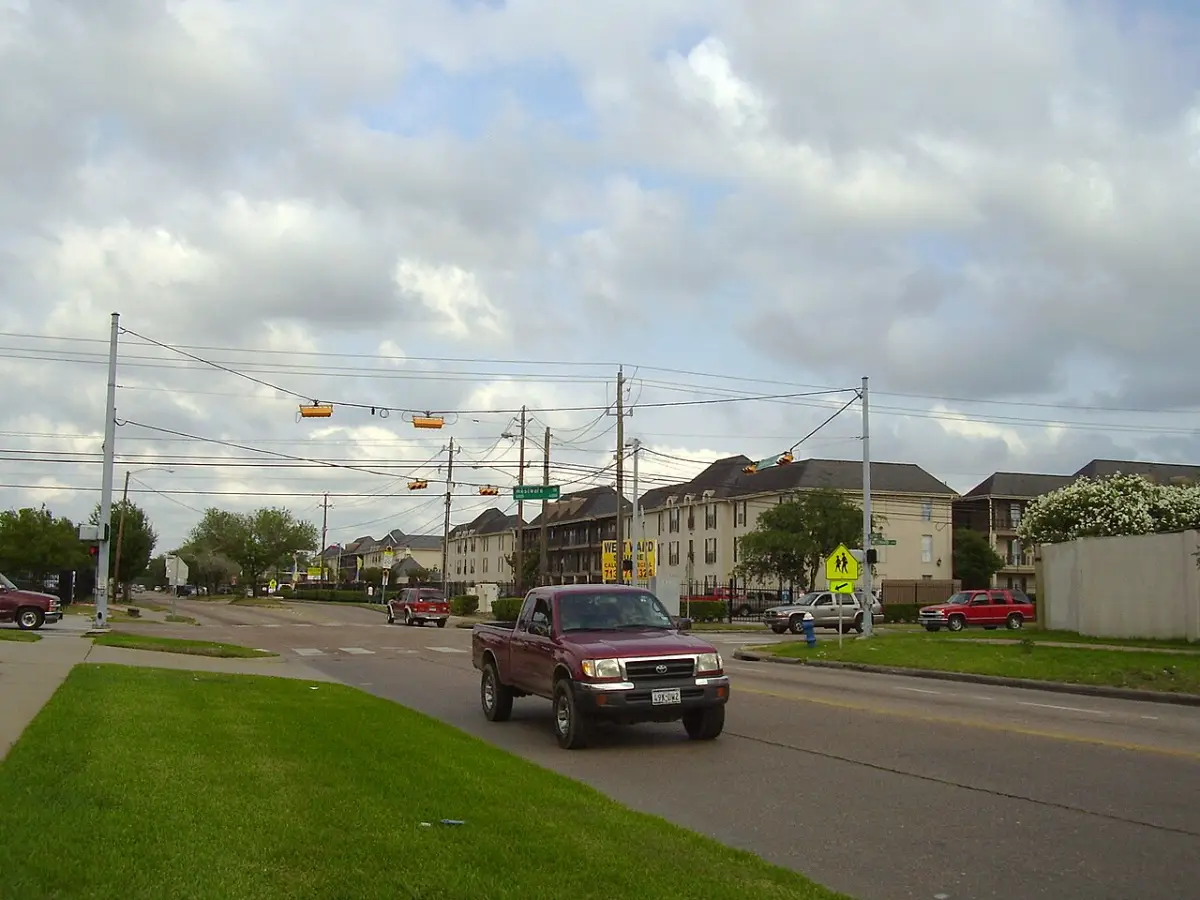
In Houston’s boom years, one apartment complex in southwest Houston advertised 17 swimming pools, 17 laundry rooms, 17 hot tubs and two clubhouses. It was built for a particular kind of tenant: young, single, mostly white, and newly arrived in a city that was booming on oil. Many had come from manufacturing towns in the Midwest and the Northeast that were losing their jobs. The neighborhood around that complex would come to be called Gulfton.
Before the apartments, there was almost nothing there. Most of Gulfton was first laid out as a rural subdivision called Westmoreland Farms, according to the City of Houston, just outside what is now Loop 610 and south of U.S. 59. The first real neighborhood, Shenandoah, came in the mid-1950s: small ranch-style houses on 16 blocks, as the designer and researcher Susan Rogers documented in a 2005 history of the area for Places Journal.
Then the apartments arrived. Construction began in the 1960s, and in the two decades that followed, thousands of units went up around Shenandoah. The farm tracts were large and the roads were far apart, which, the city notes, “made it possible for very large apartment complexes to be built,” many of them “restricted to adults.” Rogers described one Gulfton superblock as big enough to hold 16 standard downtown blocks. Nightclubs and warehouses went up alongside them, and the singles came.
The boom ended with the price of oil. When the local economy collapsed in the 1980s, thousands of people left Houston. Rents fell and apartments stood empty. The landlords who had courted young professionals went looking for new tenants, and they found them among newcomers from Vietnam, El Salvador and Mexico. Owners began advertising in Spanish, offering move-in specials, cutting rents and dropping their “adults only” rules. Not one new apartment complex was built in Gulfton between 1980 and 2000.
The people came anyway, into the buildings that were already there. The census counted 26,855 residents in Gulfton’s tracts in 1980, 31,898 in 1990 and 45,106 in 2000, nearly double in 20 years, even as the number of housing units fell because of abandonment. Community leaders believed the real number was far higher, and the census itself treated the area as hard to count.
By the early 2000s, Gulfton had become something Houston had not seen before. More than 60 percent of its residents were born outside the United States, Rogers found, and they held citizenship from 42 countries and spoke as many languages. On about three square miles, it was the densest neighborhood in the city, more than five times the city average. Central American businesses followed their customers. A Guatemalan chicken chain opened its second U.S. restaurant there, and three Salvadoran banks opened branches. Small ranch houses in Shenandoah became corner stores, auto repair shops and beauty salons.
The neighborhood also carried a hard reputation. It was nicknamed the “Gulfton Ghetto.” Shenandoah barricaded its streets to separate itself from the apartments around it, and many complexes put up gates and guards. Rogers counted more than 100 semiprivate pools, many of them filled in, and only one public park. She summed up the place in a single line: Gulfton was “simultaneously globally linked, locally severed, socially connected and physically divided.”
Houston has absorbed waves of newcomers before, from the Louisiana Creoles who built Frenchtown in the Fifth Ward to the Eastern European Jews who arrived through the Galveston Movement. What set Gulfton apart was how many places its newcomers came from, and how quickly they filled a landscape that had been built for someone else.
The city began to take formal notice. Gulfton was recognized as Super Neighborhood 27 in 2000, part of an effort to divide Houston into 88 community areas. In 2017, Mayor Sylvester Turner named it one of five pilot neighborhoods in his Complete Communities program, alongside Acres Home, Near Northside, Second Ward and Third Ward, all described by the city as historically under-resourced.
The numbers still tell the story. Census estimates for 2020 to 2024 count 44,590 people in the Gulfton super neighborhood, about 15,700 per square mile. Roughly 78 percent are Hispanic or Latino. The median household income is about $40,900.
There is more than one way to read Gulfton. One reading is a neighborhood left behind: too crowded, too hot, too short of parks and too long ignored while money flowed elsewhere in the city. Another is one of Houston’s most important front doors, where families from dozens of countries found rents they could afford and built a commercial life that did not exist before them. Both readings rest on the same record.
The one public park is now being remade. In June 2025, Harris County Precinct 4 broke ground on a rebuilt Burnett Bayland Park, with shaded trails, more trees, a community center and space for a farmers market, shaped by more than 1,000 residents who took part in planning workshops. The county says the lack of tree cover leaves Gulfton 17 degrees hotter than other parts of Houston. Sandra Rodriguez, president of the Gulfton Super Neighborhood, called the project “a representation of our park’s beauty, resiliency, and potential.” Many of the singles-era pools have long since been filled in. The people who came after the singles are still building.


