
The Road That Built Freedmen’s Town
Featured
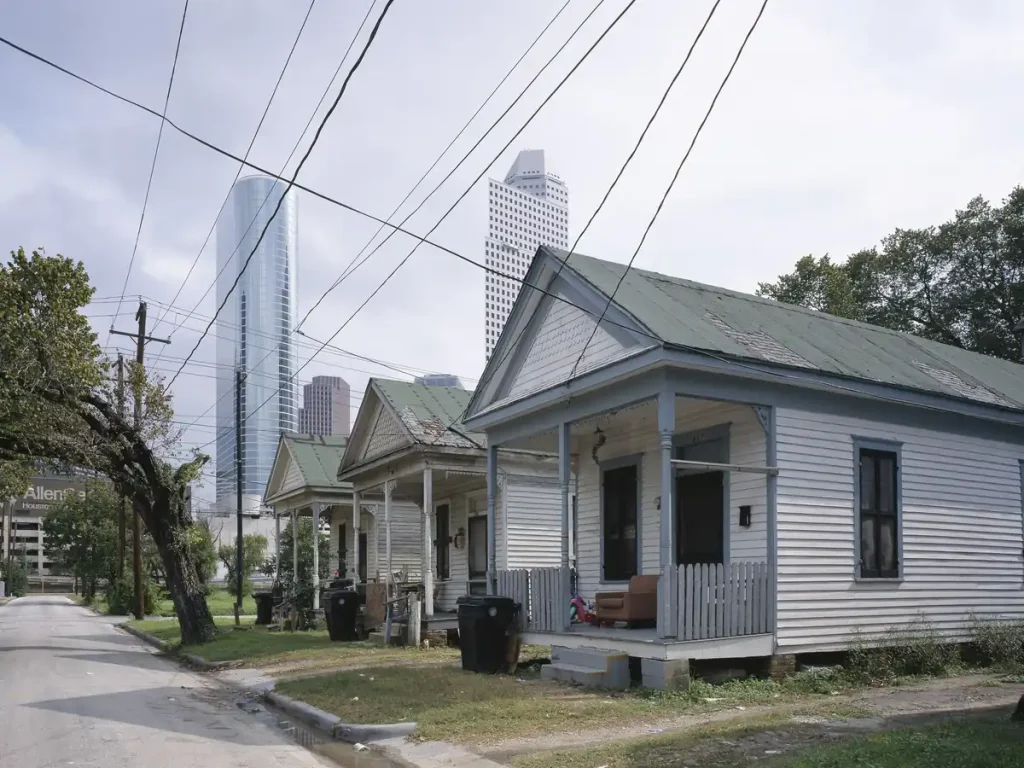
Every city has a road that explains it. In Houston, one of those roads ran southwest out of downtown toward the Brazos River plantations, and after the Civil War it carried hope as well as cotton.
It was called the San Felipe road. In the summer of 1865, it brought the freedmen in.
They came by the thousands once emancipation reached Texas. Many came up the road from the Brazos River plantations. Others had been freed inside the city itself. One former slave later remembered the day his owner, Charles S. Longcope, gathered everyone at the door of his Second Ward mansion in June 1865. Longcope read them the proclamation that set them free, and then he offered each of them a building lot in the Fourth Ward.
The Fourth Ward was an accident of paperwork before it was a home. Houston’s 1839 charter split the young city into four wards, and the fourth took the land southwest of downtown, along the south bank of Buffalo Bayou. The road changed what it would mean. The newcomers settled where the road set them down, in the stretch north of San Felipe that people began to call Freedmentown.
What they built there came fast. Two of the city’s most important Black churches rose in the ward. Trinity Methodist Episcopal Church stood at Travis and Bell. Antioch Baptist Church began at Rusk and Bagby. In 1870, the Freedmen’s Bureau schools across Houston were brought together at Gregory School, the first public school for Black children in the city.
Near the center of all of it stood a preacher named Jack Yates. With other Black ministers, he pressed for a park that Black Houstonians could call their own, and in 1872 they established Emancipation Park in the Third Ward. In 1885 Yates and Antioch founded Houston College, which moved in 1894 to the western edge of the Fourth Ward.
By the early 1900s, the road had become a main street. Shotgun houses lined the residential blocks, and many corners had a cafe, a grocery or a bar. The only Black high school in Houston stood in the ward until the mid-1920s, with a Black branch of the Carnegie Library across the street. In 1910, Black physicians opened Union Hospital on Andrews Street, near San Felipe. By 1915, all but one of the city’s Black doctors and dentists, and three out of four of its Black lawyers, kept offices in the Fourth Ward.
At night the ward turned to music. B.B. King would later call its night life the breeding ground for Arnett Cobb and Lightnin’ Hopkins. The Pilgrim Life Insurance Building, with offices, ballrooms and a roller rink on its roof, so impressed one visitor in 1930 that he called it the most beautiful Black-owned office building he had seen.
The ward was never the whole of Black Houston. It never held more than 36 percent of the city’s Black residents. But it held the institutions, and for a while that made it the heart.
Then the road began to work in the other direction.
The Fourth Ward had nowhere to grow. Other development hemmed it in, while the Third and Fifth wards had room to spread. In the 1920s, the Third Ward passed it in population and drew the new hospital, the new high school and the junior college that would become Texas Southern University.
Downtown moved in. In the 1930s, residents were displaced as land was cleared for the City Hall complex. In the early 1940s, land north of San Felipe was cleared for San Felipe Courts, a housing development for white defense workers, later renamed Allen Parkway Village. Interstate 45 cut through southwest of downtown and took many of the ward’s most important buildings with it. In the 1960s, blocks around Antioch were cleared for office buildings. The Handbook of Texas describes the church left standing on its own, cut off from its community and ringed by towers.
Almost 17,000 people lived in the ward in 1910. By 1980, fewer than 4,400 remained in what was left of it, nearly half of them below the poverty line, and only one in twenty owned a home. In the 1980s and 1990s, plans to replace Allen Parkway Village with offices and upper-income housing were slowed by residents’ opposition and by the mid-1980s downturn.
There is more than one honest way to read that history. Supporters of each project could point to real needs: a city hall, wartime housing, a freeway, offices for a booming economy. People in the ward could point to what each of those needs cost them, one block at a time. Both readings rest on the same record, set out in the Texas State Historical Association’s history of the ward.
Houston rarely keeps its old names. The San Felipe road that carried the freedmen in became San Felipe Street, and San Felipe Street became West Dallas. Readers who know the city’s neighborhoods today drive it every day, rarely wondering what stood there first.
But a road remembers what it carried. This one brought a people into a city with a promise of land, and for more than half a century they made that promise into churches, schools, a hospital and a music that the rest of the country would hear. The name on the sign has changed. The road into Freedmen’s Town is still the road that explains Houston.


