
The Ellis Island of Houston
Quick facts about Gulfton
- Gulfton is a 3.2-square-mile community in southwest Houston, between Loop 610 and Beltway 8, southeast of I-69/US 59 and north of Bellaire Boulevard; ZIP code 77081.
- About 40,000 to 47,000 people live there, depending on the boundary used; it is the most densely populated community in Houston, at roughly 16,000 people per square mile.
- Residents come from more than 50 countries and speak more than 50 languages; in the 2019–2023 ACS, 25,073 of 43,793 super-neighborhood residents were born outside the United States.
- Before 1950 it was farmland; the apartment complexes that define it were built in the 1960s and 1970s for young oil workers from the Northeast and Midwest.
- The 1980s oil bust emptied the complexes; owners then marketed them to newly arrived immigrants, and by 2000 Gulfton was 71% Hispanic.
- It is often called Houston’s Ellis Island, a name used by the Gulfton Neighborhood Council and by BakerRipley’s Angela Blanchard.
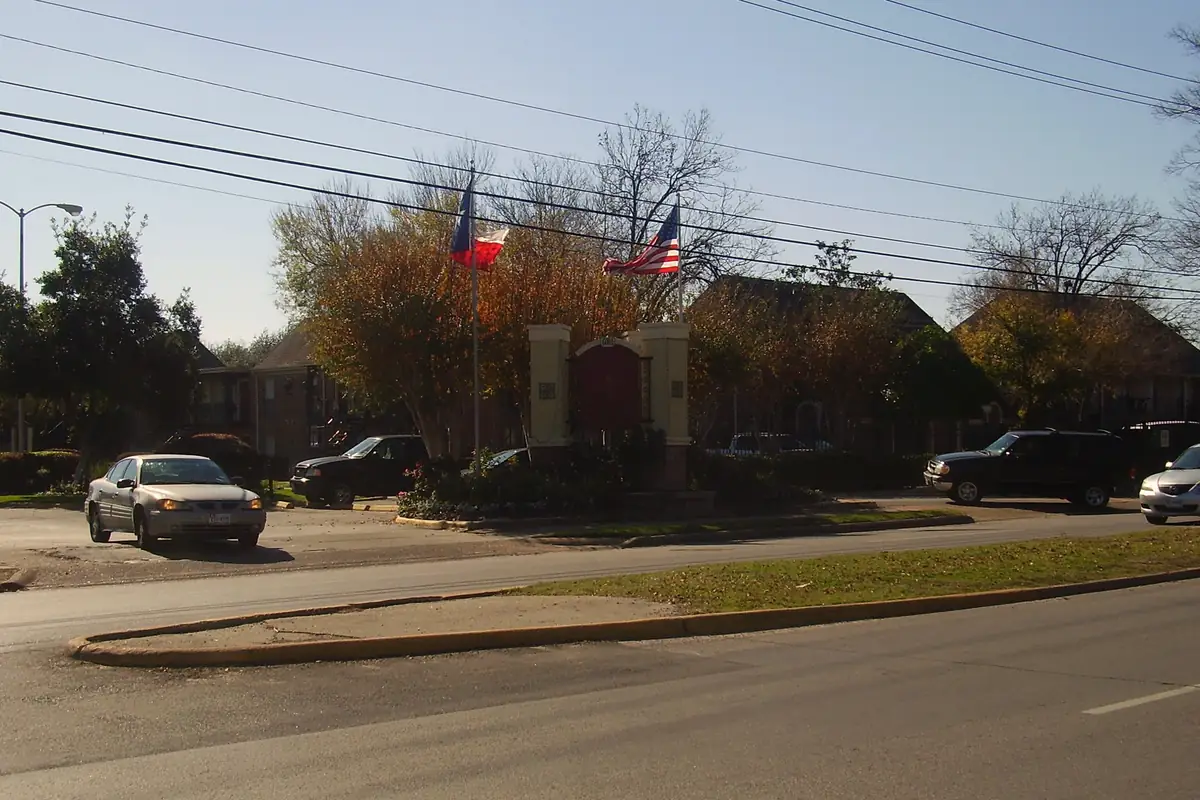
In parts of Central America, people do not say they are coming to Texas or Houston. They say they are coming to Gulfton. The name has travelled further than the place itself. Gulfton is a 3.2 square mile patch of southwest Houston, between Loop 610 and Beltway 8, a grid of big apartment complexes about fifteen minutes from the Galleria. Around 40,000 people live in those complexes, in more than 15,000 apartments, and they speak more than 50 languages. It is the most densely populated community in the city, and the first stop in America for a great many of its residents.
Before 1950 almost all of it was farmland, much of it Westmoreland Farms, flat prairie on the edge of town. In the mid 1950s the Shenandoah subdivision went up on sixteen city blocks of ranch style homes, beside parcels that would soon fill with apartments. When the apartments around Shenandoah began to run down, the older subdivision and the complexes beside it fell into open conflict over what the area was becoming.
The complexes came fast in the 1960s and 1970s, built for young, mostly white workers from the Northeast and Midwest who had come to Houston for oil industry jobs in the boom years. The developers gave the buildings fancy names, Napoleon Square and Chateau Carmel among them, and competed on amenities. One complex boasted seventeen swimming pools, seventeen laundry rooms, seventeen hot tubs and two clubhouses, and some offered a free VCR to anyone signing a one year lease. Rice University scholar Jim Gaines has written that the build was not well planned. The oil work that filled the apartments flowed through the Houston Ship Channel, and the channel’s port economy set the rhythm of the whole district.
Then the oil bust of the mid 1980s emptied the place. More than 200,000 jobs left the local economy, renters moved away, and complexes went bankrupt and were foreclosed. Colonial House Apartments was taken over and auctioned on 11 May 1989 for 8.9 million dollars, and renamed Lantern Village the next year. The owners turned to the people arriving, advertising in Spanish, dropping adults only policies, cutting rents and offering move in specials, and Gulfton became a predominantly immigrant community. By 2000 it was 71 percent Hispanic. The Hispanic population had risen from 18,422 in the 1990 census to 33,424 in 2000, up 81 percent. Many came from Mexico and Central America, and in 1985 Salvadoran immigrants opened CARECEN to offer legal services. Newer arrivals have come from Venezuela, Honduras, Cuba, Guatemala, Colombia and Puerto Rico, building a community from the ground up in the same way the freedmen of Freedmen’s Town had done a century earlier.
Gulfton is not the first Houston neighbourhood remade by newcomers arriving with almost nothing. The Fifth Ward was remade that way generations earlier. In Gulfton the change came faster and harder. Crime rose in the 1980s and the schools were overwhelmed, and Houstonians dubbed the area the Gulfton Ghetto. The city answered with more police and new schools, and in July 1989 the City Council designated Gulfton a Community Development Target, bringing increased city services. On 11 July 1998 Houston police officers acting on a drug tip entered a Gulfton apartment and shot and killed Pedro Oregon Navarro, and no illicit drugs were found on the property. A Harris County grand jury cleared the officers that October, and the family’s lawsuit was dismissed by a federal judge in 2000. It is one hard chapter in a longer story.
The institutions arrived after the people did. In 1991 the Sisters of Charity Southwest Health Clinic opened, Gulfton’s first major health clinic. In 1993 Gulfton gained 500 new street lights, paved streets and new sidewalks. In 1997 a federal National Weed and Seed designation brought close to 7 million dollars in grants, and the Gulfton Community Learning Center ran free English, citizenship and computer classes, while the Campo del Sol summer camp served more than 3,000 children. In 2003 Neighborhood Centers, now BakerRipley, began organising in Gulfton, and its director Angela Blanchard called the area Houston’s Ellis Island. In 2010 the 20 million dollar BakerRipley Neighborhood Center opened in the heart of Gulfton, and in 2007 the City had opened the Southwest Multi-Service Center serving Gulfton and Sharpstown.
The schools tell the same story of a place built for arrivals. Gulfton is zoned to Houston ISD, and its elementary schools are Cunningham, Braeburn, Condit and Benavidez. Most high schoolers attend Margaret Long Wisdom High School, formerly Robert E. Lee High School, which opened in 1962, with Lamar and Westside as options, and some areas are zoned to Bellaire High School. The district’s boundaries and choices are set out in our guide to Houston school districts, and the classrooms here keep absorbing new Houstonians.
Today the name holds up. People usually call it the Ellis Island of Houston, says Sandra Rodriguez, President of the Gulfton Neighborhood Council, and the commercial spine is Bellaire Boulevard, Hillcroft Street, Chimney Rock Road and Bissonnet Street. As of 2010 Gulfton had citizens of 82 countries, and today more than 50 languages are spoken in its apartment blocks. It has a community college campus, Burnett Bayland Park and a public library. It is one of the hottest parts of the city in summer, running 10 to 17 degrees higher than greener areas. What Gulfton is for has not changed since the first tenants arrived. It is the place where people land first, find their footing, and start again.


